Ninja and Samurai Were Never the Same Thing
If you grew up watching Naruto, you probably thought ninja and samurai were just two flavors of the same cool Japanese fighter. Both had swords (or sword-adjacent weapons). Both had intense training. Both popped up in period anime. Here's the thing - the gap between ninja and samurai is one of the biggest class divides in Japanese history. They came from different social worlds, followed completely opposite codes, and viewed each other with barely disguised contempt.
Naruto is pure ninja fantasy. Demon Slayer is samurai-coded from top to bottom. Sekiro is specifically about a ninja in the service of a samurai lord - and the whole tension of that game only makes sense if you understand what those words actually mean. Once you do, you start reading anime and games completely differently.
And as a bonus, the vocabulary split between these two worlds gives you a huge chunk of the Japanese you'll encounter in anime lyrics, dialogue, and game text.
Key Takeaways
- Samurai (侍, samurai) were Japan's official aristocratic warrior class - military nobility with legal status, two swords, and an honor code
- Ninja (忍者, ninja) were shadow operatives - spies, saboteurs, assassins - often from the farmer class with no official status and no honor code
- The ninja's proper name is shinobi (忍び, shinobi) - "one who endures/steals away" - 忍者 is a compound that appeared later
- The key character: 忍 (blade over heart) means endurance and concealment - it appears in shinobi, ninjutsu, and in Naruto's entire vocabulary framework
- Real ninja schools - Iga-ryu (伊賀流) and Koka-ryu (甲賀流) - were documented organizations with preserved training manuals
- Naruto names every village by element + shadow: Hokage (火影, fire shadow), Konoha (木の葉, leaf) - real Japanese compounding you can decode yourself
The Samurai: Japan's Official Warrior Class
Samurai (侍, samurai) - also called bushi (武士, bushi) - were the military aristocracy of feudal Japan. Not just skilled fighters. A recognized social class, a political institution, and the only people legally allowed to wear two swords in public.
The class emerged in the 9th and 10th centuries when the imperial court in Kyoto started hiring provincial warriors to enforce order in the countryside. Over centuries these warriors accumulated land, power, and eventually enough strength to install their own shogunate government - in Kamakura in 1185. For the next 700 years, samurai ran Japan. The Sengoku period (戦国時代, Sengoku jidai, roughly 1467-1615) was when rival samurai lords fought to control the whole country, and when the ninja flourished as their shadow tools.
The samurai code was Bushido (武士道, bushidō) - the "way of the warrior." At its core: absolute loyalty to your lord (主, aruji), honor above survival, and death before surrender. A samurai who failed his lord or was dishonored was expected to commit seppuku (切腹, seppuku) - ritual self-disembowelment. The word 武士道 breaks down perfectly: 武 (bu, martial), 士 (shi, warrior), 道 (dō, way/path).
Samurai fought in the open. They wore yoroi (鎧, yoroi) - elaborate lacquered armor designed to be seen. Their primary weapon was the katana (刀, katana), paired with a shorter wakizashi (脇差, wakizashi). That two-sword set is the daisho (大小, daishō) - literally "big-small" - wearing it in public was a legal privilege reserved for samurai alone.
Their entire identity was about being known, being present, and meeting death openly.

The Ninja: Shadow Operators, Not Warriors
Here's what most people get wrong: ninja were not failed samurai or samurai who chose a different style. They were a different category of person.
The proper historical term is shinobi (忍び, shinobi), short for shinobi no mono (忍びの者, shinobi no mono) - "one who endures" or "one who steals away." The character 忍 (nin/shinobi) is made up of 刃 (ha, blade) over 心 (kokoro, heart). A blade pressing down on the heart. Endurance. The ability to keep going under pressure while revealing nothing.
Ninja emerged prominently during the Sengoku era - Japan's most chaotic period of civil war. Samurai armies needed intelligence. They needed someone to infiltrate enemy castles, gather information, sabotage supply lines, and if necessary, reach targets that couldn't be fought in open battle. Enter the shinobi.
Two provinces became the center of professional ninja operations: Iga (伊賀, Iga) and Koka (甲賀, Kōka). Their schools - Iga-ryu (伊賀流, Iga-ryū) and Koka-ryu (甲賀流, Kōka-ryū) - were real organizations with documented techniques and preserved training scrolls. The Iga Ninja Museum in Mie prefecture still stands today.
Most critically: ninja often came from the farmer class (農民, nōmin), not the warrior class. No Bushido code. Their art - ninjutsu (忍術, ninjutsu) - was not about honor. It was about accomplishing the mission by any means: hensou (変装, hensō, disguise), ansatsu (暗殺, ansatsu, assassination), choho (諜報, chōhō, espionage). Where a samurai who used deception in battle lost face, for a shinobi deception was the entire point.

The Core Difference: Honor vs Shadows
The single clearest way to understand the gap: a samurai's identity required being known. A ninja's identity required being invisible.
Samurai wore identifying crests (家紋, kamon, family crest) on their armor. They announced themselves before combat. They had formal rank within a recognized military hierarchy. When Kenshin from Rurouni Kenshin wanders around with a reverse-blade sword and refuses to kill, that's Bushido operating even in a post-samurai world - a warrior defined by the code he carries, not just the techniques he uses.
A shinobi's survival depended on no one knowing they were there. Hensou (変装, hensō, disguise) wasn't a backup plan - it was primary. Ninja manuals describe using disguises as Buddhist monks, merchants, street performers, and farmers. Kage (影, kage, shadow) and yami (闇, yami, darkness) weren't poetic words for ninja - they were operational environments.
The loyalty structure also differed fundamentally. Samurai had chugi (忠義, chūgi, loyalty and duty) to a specific lord - that bond was sacred and lifelong. Ninja clans sometimes operated more independently, and ronin (浪人, rōnin, masterless samurai) who lost their lord sometimes crossed into shinobi work as a survival strategy. The line was more blurred than anime suggests.
The Weapons Tell the Story
The tool difference makes the philosophy difference concrete.
A katana is a display object as much as a weapon. Handcrafted by a master swordsmith over weeks, worn visibly on the hip, passed down through generations with its own name. You cannot sneak with a katana.
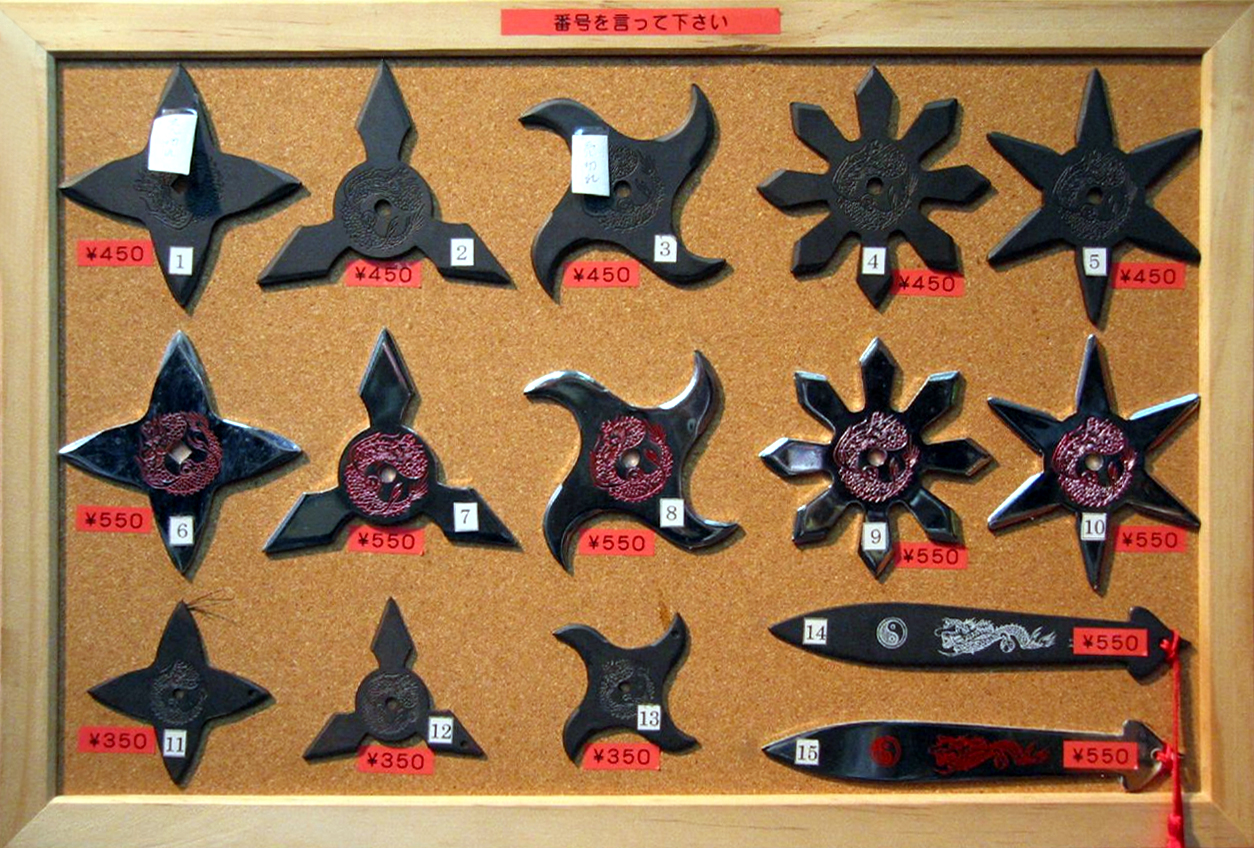
Kunai (苦無, kunai) were originally farming tools - thick iron stakes used to dig in soil - repurposed for climbing walls, throwing, and close combat. Shuriken (手裏剣, shuriken) breaks down beautifully: 手 (te, hand) + 裏 (ura, hidden/behind) + 剣 (ken, sword). "A sword hidden in the hand." They weren't designed to kill - they were designed to distract or create an opening to flee or to strike from a different angle.
The kusarigama (鎖鎌, kusarigama) - a sickle connected to a weighted chain - started as a farming tool. The chain could entangle a samurai's sword. The sickle could hook around armor gaps. It was designed specifically to work against a predictable, honor-bound fighter.
Ninja also used makibishi (撒き菱, makibishi, caltrops), smoke bombs, fukiya (吹き矢, fukiya, blowguns firing poisoned darts), and concealed blades. None of these are honorable weapons. All of them are effective ones.
The Anime and Game Connection
Once you understand the real split, you start reading anime and games completely differently.
Naruto - Pure Ninja Fantasy
Masashi Kishimoto built Naruto's world on the ninja framework but ran it through total mythologization - chakra (チャクラ, chakura, taken from Hindu/Sanskrit), elemental affinities, summoned animals, hidden villages.
But the naming follows real Japanese logic. Naruto's village is Konohagakure (木ノ葉隠れの里, Konoha-gakure no Sato) - "Village Hidden in the Leaves." Break it down: 木の葉 (konoha, leaf/leaves), 隠れ (kakure, hidden), 里 (sato, village). The village leader's title Hokage (火影, Hokage) literally means "fire shadow" - 火 (hi/ka, fire) + 影 (kage, shadow). Every hidden village follows this compound pattern: Sunagakure (砂隠れ, sand-hidden), Kumogakure (雲隠れ, cloud-hidden), Kirigakure (霧隠れ, mist-hidden). You can decode them all once you know the pieces.
The word jutsu (術, jutsu, technique/art) in Naruto is real Japanese vocabulary. Ninjutsu (忍術), genjutsu (幻術, illusion technique), taijutsu (体術, body technique) - each compound is transparent if you know the kanji. And the core character 忍 (nin/shinobi) - endurance, concealment - sits at the heart of the whole series.
Demon Slayer - The Samurai Code, Reborn
Demon Slayer is set in Taisho-era Japan (1912-1926) - decades after the samurai class was abolished - but Tanjiro and the Demon Slayer Corps operate almost entirely within samurai ethics. Their kokyu (呼吸, kokyū, breathing technique) is kenjutsu (剣術, kenjutsu, sword technique) with a supernatural layer.
Tanjiro's absolute commitment to protecting his sister, his refusal to dehumanize even the demons he kills, his acceptance of his own death as a cost of the mission - that's Bushido internalized at the bone level. The Hashira (柱, hashira, pillars) each embody a specific samurai virtue: Rengoku's unbreakable valor, Himejima's stoic duty, Mitsuri's personal honor code. Even the title 鬼滅の刃 (Kimetsu no Yaiba) uses 滅 (metsu, annihilation/destruction) - a term from the samurai military vocabulary, gokimetsu (撃滅, to annihilate an enemy).
Sekiro - Where Both Worlds Meet
Sekiro might be the most accurate single game for capturing the actual historical relationship between ninja and samurai. You play as Sekiro (隻狼, Sekiro, "one-armed wolf") - a shinobi in service to Kuro, a young samurai lord. Your tools are shinobi tools: the grappling hook, the shuriken, infiltration. Your loyalty is samurai loyalty - absolute, unconditional.
The whole game's premise directly encodes the historical reality: ninja worked for samurai commanders. The tension the game creates comes from a ninja's operational methods (stealth, assassination, deception) being used to fulfill a samurai's code (loyalty unto death). Those two things shouldn't fit together cleanly - and the game knows it.
Bleach - Soul Reapers as Samurai Hierarchy
Bleach's Gotei 13 is structured as a samurai military hierarchy. Each Soul Reaper's zanpakuto (斬魄刀, zanpakutō) - "soul-cutting sword" - is a katana analog with a name, a spirit, and a relationship built over years of shugyo (修行, shugyō, austere training). Captains have absolute authority over subordinates, exactly like a samurai chain of command. Byakuya Kuchiki's entire arc is about which samurai virtue - law and duty or personal love - takes precedence when they conflict. That question is specifically a Bushido question.
Jujutsu Kaisen - A Word About That Title
The jujutsu in Jujutsu Kaisen is 呪術 (jujutsu) - 呪 (curse/spell) + 術 (technique) - "curse technique." But there's a completely different 柔術 (jujutsu) that means "flexible technique" - 柔 (soft) + 術 (technique) - the real martial art that became judo and Brazilian jiu-jitsu. Same pronunciation, completely different kanji. This kind of homophone confusion is exactly why reading kanji matters when learning Japanese through anime.
Vocabulary Callout
35 words that unlock the ninja and samurai worlds across anime, games, and Japanese lyrics:
| Kanji | Romaji | Meaning |
|---|---|---|
| 忍者 | ninja | ninja, person of stealth |
| 忍び | shinobi | one who endures/conceals |
| 忍 | nin / shinobi | endurance + concealment (the core kanji) |
| 侍 | samurai | samurai warrior |
| 武士 | bushi | warrior (broader term than samurai) |
| 武士道 | bushido | way of the warrior |
| 忍術 | ninjutsu | art/techniques of the ninja |
| 剣術 | kenjutsu | sword technique |
| 柔術 | jujutsu | flexible/yielding technique (real martial art) |
| 術 | jutsu | technique, art, method |
| 刀 | katana | sword (the long samurai blade) |
| 脇差 | wakizashi | short sword (paired with katana) |
| 大小 | daisho | the paired swords of a samurai |
| 手裏剣 | shuriken | throwing star (lit. sword hidden in hand) |
| 苦無 | kunai | kunai blade (originally a farming tool) |
| 鎌 | kama | sickle (basis of kusarigama) |
| 鎧 | yoroi | armor |
| 影 | kage | shadow |
| 闇 | yami | darkness |
| 秘密 | himitsu | secret |
| 暗殺 | ansatsu | assassination |
| 変装 | hensou | disguise, masquerade |
| 諜報 | choho | espionage, intelligence gathering |
| 忠義 | chugi | loyalty and duty |
| 名誉 | meiyo | honor |
| 流派 | ryuha | school or style of martial art |
| 伊賀流 | Iga-ryu | Iga school of ninjutsu |
| 甲賀流 | Koka-ryu | Koka school of ninjutsu |
| 修行 | shugyo | austere training |
| 里 | sato | village |
| 武器 | buki | weapon |
| 天下 | tenka | the realm, the whole country |
| 戦国 | sengoku | warring states (the era when ninja flourished) |
| 火影 | Hokage | fire shadow (Naruto's village leader title) |
| 木の葉 | konoha | leaf (Naruto's hidden village name) |
The particle の (no) appears throughout this vocabulary - 忍びの者 (shinobi no mono, person of stealth), 木の葉 (ko-no-ha, leaf of the tree), 武士の道 (bushi no michi, way of the warrior). It's the possessive/connector particle, and you'll hit it constantly in anime lyrics, titles, and poetry.
The core kanji in this vocabulary each carry their meanings in their components. 忍 (nin/shinobi) means endurance or concealment. 刃 (blade) over 心 (heart), a sword pressing down on the heart. 術 (jutsu) means technique or art. It appears in 忍術 (ninjutsu), 剣術 (kenjutsu, sword technique), and 柔術 (jujutsu, flexible technique). 影 (kage) means shadow. Naruto encodes it into every hidden village leader's title. And 武 (bu) means martial or military. The root of 武士 (bushi, warrior), 武器 (buki, weapon), and 武士道 (bushido, the way of the warrior).
Why This Matters for Your Japanese
The kanji 忍 (nin/shinobi) is one of the most useful characters in anime vocabulary because it keeps showing up far outside ninja contexts. 忍耐 (nintai, patience/perseverance), 忍ぶ (shinobu, to endure/conceal, also a common name), 隠忍 (innin, hidden endurance). When characters in any genre "endure" or "push through" something, there's a good chance 忍 is involved somewhere in the Japanese text.
The samurai side gives you the 武 (bu, martial) family of words, which runs through battle anime constantly: 武器 (buki, weapon), 武術 (bujutsu, martial art), 武道 (budo, martial way). Know 武 = martial and 道 = way/path and you can decode compound words on the fly. 剣道 (kendo, way of the sword), 柔道 (judo, way of flexibility), 空手道 (karate-do, way of the empty hand) - all the same structure.
When you're listening to an anime opening and you catch 影 (kage, shadow), or 刃 (ha, blade), or 忍 (shinobi) in the lyrics, you're now catching a layer of meaning that was always there. KitsuBeat lessons are built around exactly these moments - anime songs where the vocabulary in the lyrics ties directly to the historical and cultural weight behind the show.
For the full samurai side of this story, the Rurouni Kenshin and Meiji Restoration article covers what ended the samurai era and why Kenshin is built around that collapse. The Bushido article breaks down all seven virtues and why Tanjiro, Zoro, and Byakuya are all essentially following the same code from different angles.
Explore the song library on KitsuBeat - search any anime and look for the vocabulary callouts in each lesson. Or browse the full Journal for more deep dives into the Japanese hiding inside the anime you already love.
FAQ
Were ninja real historical figures?
Yes. Ninja - properly called shinobi (忍び) - were documented historical operatives active primarily during Japan's Sengoku era (roughly 1467-1615). The Iga and Koka provinces of central Japan produced the most famous schools of ninjutsu. Historical records from warlords like Oda Nobunaga document the use of shinobi for espionage and infiltration. The Iga Ninja Museum in Mie Prefecture preserves actual training equipment and historical manuals.
What does shinobi mean in Japanese?
Shinobi (忍び) means "one who endures" or "one who steals away." The character 忍 combines 刃 (blade) over 心 (heart) - a blade over the heart, representing the endurance required to operate in secret. Shinobi is the older, more historically accurate term for ninja; "ninja" is a more modern compound reading of the same characters 忍者.
What is the difference between ninja and samurai?
Samurai (侍) were Japan's official aristocratic warrior class - military nobility with recognized social rank, a legal code, and the right to carry two swords. Ninja (忍者) were shadow operatives - spies, saboteurs, and assassins - often from lower social classes, with no official status and no honor code. Samurai fought openly in daylight bound by Bushido; ninja operated in darkness using deception and any means necessary.
Is Naruto a realistic portrayal of ninja?
No - Naruto is fantastical and mythologized. Real ninjutsu had no chakra system, no elemental transformations, and no giant summoned animals. But Kishimoto preserved real vocabulary: shinobi (忍び), jutsu (術), and the village naming conventions like Konoha (木の葉, leaf) and Hokage (火影, fire shadow). The emotional core - endurance and operating outside the honorable warrior code - does reflect the historical reality of shinobi.
Is Tanjiro from Demon Slayer following Bushido?
Not explicitly, but structurally yes. The Demon Slayer Corps operates on samurai ethical principles without naming them: absolute loyalty to the mission, protection of innocents, acceptance of death over retreat, and respect for enemies. Tanjiro's breathing techniques (呼吸, kokyu) function like a martial path (道, do) - the same structure as kendo or judo. Demon Slayer is built on Bushido bones even if it never says the word.
What does the word jutsu mean in Japanese?
Jutsu (術) means technique, art, or method. It appears in ninjutsu (忍術, art of the ninja), kenjutsu (剣術, sword technique), jujutsu (柔術, flexible technique), and in Naruto's usage as a general shorthand for supernatural techniques. In everyday Japanese it compounds widely: bijutsu (美術, fine art), gijutsu (技術, technology/skill), majutsu (魔術, magic/sorcery).
What is the Jujutsu in Jujutsu Kaisen - is it the same as the martial art?
No - different kanji, same pronunciation. Jujutsu Kaisen uses 呪術 (jujutsu), meaning curse technique - 呪 (curse/spell) + 術 (technique). The martial art is 柔術 (jujutsu), meaning flexible technique - 柔 (soft/flexible) + 術 (technique). Same pronunciation, completely different meaning. This homophone situation is exactly why reading kanji matters when learning Japanese through anime.
What ninja schools actually existed in Japanese history?
Two provinces became famous as centers of professional ninja operations: Iga (伊賀) and Koka (甲賀), in present-day Mie and Shiga prefectures. Their schools - Iga-ryu (伊賀流) and Koka-ryu (甲賀流) - were documented organizations with preserved training manuals called ninja scrolls. The Iga Ninja Museum in Mie Prefecture still displays historical artifacts from these schools. Other regional schools existed but Iga and Koka were historically the most prominent.